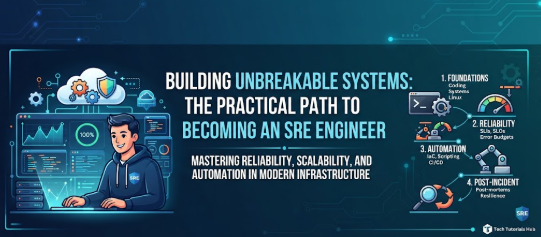
Building Unbreakable Systems: The Practical Path to Becoming an SRE Engineer
Introduction
Modern software applications run around the clock. When a popular streaming service, online banking app, or e-commerce website goes down for even a few minutes, thousands of users get frustrated, and businesses lose millions of dollars.
To prevent these outages, modern tech teams rely on Site Reliability Engineers. However, finding structured learning paths can be challenging for newcomers and traditional system administrators alike. Without proper operational frameworks, teams spend all their time putting out fires manually instead of building new features.
This guide explores how structured SRE Training, professional certifications, tutorials, and proven tools help engineers build dependable, resilient modern technology platforms.
What Is Site Reliability Engineering?
At its core, Site Reliability Engineering is what happens when you ask a software engineer to design an operations team. Instead of manually fixing servers when they crash, an SRE writes code and automation scripts to manage infrastructure and prevent crashes automatically.
Why Does It Matter?
Traditional IT operations rely heavily on human intervention. When a server runs out of memory or a database locks up, an engineer must log in and fix it by hand. This approach does not scale when managing thousands of cloud servers. SRE applies software solutions to operational problems, ensuring systems remain stable as they grow.
A Simple Example
Imagine a busy restaurant kitchen. A traditional operations approach has cooks frantically washing dishes, taking orders, and cooking all at once whenever a rush hits. An SRE approach installs an automated dishwasher, sets up an electronic ordering system, and creates a clear checklist so every meal comes out fast and mistakes stay rare.
How SRE Works in Practice
Site Reliability Engineering relies on specific concepts to measure system health and control risk. Understanding these core ideas is the main goal of any comprehensive SRE Tutorial or training curriculum.
Service Level Indicators (SLIs)
An SLI is a carefully chosen metric that measures how well a system is performing. Common examples include:
- Latency: How long it takes a server to reply to a user request.
- Error Rate: The percentage of requests that fail compared to successful ones.
- Throughput: How many requests the system can handle per second.
Service Level Objectives (SLOs)
An SLO is the target goal for your SLI. For example, your team might agree that 99.9% of all user requests must succeed within half a second.
Error Budgets
An error budget represents how much downtime or failure is acceptable over a specific period. If your SLO is 99.9% uptime, your error budget is 0.1%.
- If the system stays well within the error budget, developers can release new features quickly.
- If too many errors occur and the budget runs out, feature releases pause until reliability gets restored.
Why Pursue SRE Training and Certification?
As cloud infrastructure grows more complex, organizations actively look for certified professionals who understand how to keep production systems healthy.
Benefits of Structured Learning
- Practical Problem Solving: Learn how to manage incidents calmly and effectively using structured runbooks.
- Automation Mastery: Replace repetitive manual tasks with automation scripts and infrastructure-as-code tools.
- Career Growth: Organizations worldwide value engineers who know how to protect revenue by keeping critical systems online.
SRE Training in India and Globally
High-quality SRE Training in India and around the world provides hands-on labs, real-world troubleshooting scenarios, and mentorship from experienced production engineers. Enrolling in a dedicated SRE Course gives learners a clear path from foundational operating concepts to advanced incident management and observability practices.
Important SRE Tools and Technologies
An SRE engineer relies on a modern toolkit to monitor, automate, and secure production environments.
- Observability Tools: Platforms like Prometheus, Grafana, and Datadog collect metrics, logs, and traces so engineers can see inside running applications.
- Infrastructure as Code (IaC): Tools like Terraform allow engineers to define cloud servers and networks using code rather than manual clicks.
- Container Orchestration: Kubernetes automates the deployment, scaling, and management of containerized applications across clusters.
- Incident Management: Tools like PagerDuty help route alerts to the right on-call engineer quickly when something breaks.
Common Mistakes Beginners Make
When learning Site Reliability Engineering, practitioners often fall into predictable traps.
- Mistake: Treating SRE as just another name for traditional system administration.
- Why it happens: People assume writing code is optional for operations roles.
- Why it causes problems: Without software engineering skills, teams cannot build the automation needed to scale.
- What to do instead: Learn basic programming and automation scripting alongside Linux and networking fundamentals.
- Mistake: Setting unrealistic SLO targets like 100% uptime.
- Why it happens: Teams want to impress management with perfect numbers.
- Why it causes problems: Achieving 100% uptime is virtually impossible and slows down innovation completely.
- What to do instead: Set realistic targets based on user expectations and business needs, such as 99.9% or 99.95%.
- Mistake: Ignoring human burnout in on-call rotations.
- Why it happens: Relying on the same senior engineers to handle every night alert.
- Why it causes problems: Constant pager fatigue leads to missed alerts and staff turnover.
- What to do instead: Share on-call duties fairly, automate repetitive alerts, and hold blameless post-mortems after incidents.
Risks and Limitations of SRE Adoption
While SRE principles offer massive benefits, adopting them requires careful planning.
- Cultural Resistance: Traditional development and operations teams may resist working together or sharing responsibility for production stability.
- High Initial Effort: Setting up comprehensive monitoring, SLOs, and automation pipelines takes time before showing a return on investment.
- Complexity Overhead: Introducing advanced container and orchestration tools can overwhelm small teams if their applications are simple.
Decision Framework: Is SRE Right for Your Team?
Before diving into complex reliability frameworks, evaluate your current operational maturity using these steps:
- Assess Frequency of Outages: Are your systems failing often due to manual deployment errors or invisible bugs?
- Measure Time Spent on Toil: Are your engineers spending most of their day doing repetitive manual fixes rather than building features?
- Check Monitoring Gaps: Do you know why your application failed only after customers complain on social media?
- Evaluate Team Skills: Does your team have basic coding, scripting, and cloud infrastructure experience?
- Start Small: Implement basic SLO tracking and automated backups before building complex Kubernetes clusters.
Checklist for Aspiring SRE Engineers
Use this checklist to track your learning progress toward becoming a skilled SRE Engineer:
- Master Linux operating system fundamentals and command-line tools.
- Learn at least one scripting language (such as Python or Bash).
- Understand networking basics (DNS, TCP/IP, HTTP, load balancers).
- Study containerization with Docker and orchestration with Kubernetes.
- Learn how to configure monitoring, metrics collection, and log aggregation.
- Understand how to define SLIs, SLOs, and error budgets.
- Practice incident response and blameless post-mortem writing.
- Earn a recognized SRE Certification to validate your knowledge.
Key Terms
- Toil: Repetitive, manual operational work that offers no enduring service value and scales linearly with system growth.
- Blameless Post-Mortem: A meeting held after an incident to analyze what went wrong technically without blaming individual human error.
- Runbook: A documented guide detailing step-by-step instructions for performing routine administrative tasks or troubleshooting known system alerts.
- Latency: The total time it takes for a system to process a request and return a response.
- Containerization: A lightweight virtualization method that packages an application together with all its required dependencies.
FAQs
What is the difference between DevOps and SRE?
DevOps is a cultural philosophy focused on breaking down silos between development and operations teams to release software faster. SRE is a specific implementation of that philosophy that treats operations as a software engineering problem, focusing heavily on uptime, availability, and error budgets.
Do I need to know how to code to become an SRE?
Yes. Because SRE involves automating manual tasks and building reliability tooling, you need solid foundational programming or scripting skills in languages like Python, Go, or Bash.
How long does it take to complete an SRE training course?
Depending on your prior experience in IT or software development, a comprehensive training program usually takes anywhere from a few weeks to several months of dedicated study and hands-on lab work.
What background is best for starting SRE training?
System administrators, cloud support engineers, software developers, and DevOps practitioners find the transition to Site Reliability Engineering the smoothest due to their existing technical background.
Are SRE certifications worth the effort?
Yes. Structured certifications help validate your operational knowledge to employers, structure your learning path efficiently, and demonstrate your commitment to modern engineering standards.
Conclusion
Building resilient, highly available technology platforms requires more than just good luck—it requires deliberate engineering practices. By combining automated tooling, clear service level objectives, and a culture of continuous learning, modern teams can prevent costly outages before they happen. Whether you are taking your first steps with an introductory tutorial or pursuing an advanced professional certification, mastering reliability engineering is one of the most valuable investments you can make in your technical career.
Leave a Reply