IVF Abroad: Key Factors to Review Before Choosing a Country
Introduction
Exploring assisted reproductive technology can bring up many questions for individuals and couples. Understanding how fertility care works, what treatments involve, and how to research providers properly are important steps in this journey. IVFHospitalsNow is an independent fertility-care education, research, and provider-discovery platform designed to help people navigate these choices with clarity. Because fertility care involves medical procedures, financial planning, and personal decisions, gathering reliable information across treatments, costs, success rates, clinics, testing, and international options helps patients prepare for informed discussions with medical professionals.
What Is IVFHospitalsNow?
IVFHospitalsNow is an independent platform built to support individuals and couples exploring assisted reproductive care. It is designed for patients who want to understand their options before making major healthcare decisions. The platform covers a wide range of fertility information, combining educational resources with tools for finding, evaluating, and comparing fertility providers. Rather than focusing on promotional rankings, it emphasizes sourced information, transparent verification status, cost factors, and properly interpreted outcome data. By bringing together education, country research, and verified provider details, the platform helps readers ask better questions and build a solid foundation of knowledge alongside qualified medical specialists.
Why Careful Fertility Research Matters
Making choices about reproductive healthcare requires looking at more than a single piece of information. People often need to research multiple factors before deciding on a care path. These areas include treatment types, financial requirements, expected outcomes, diagnostic tests, clinic details, doctor qualifications, and geographic location. Regulations and available reproductive technologies can also vary significantly. Relying on one single review, a single percentage, or a marketing ranking can hide important details. Thorough research helps patients understand what to expect during treatment and ensures they consider all relevant aspects of their care.
Understanding the IVF Treatment Journey
In-vitro fertilization, commonly known as IVF treatment, is a medical process where eggs are collected from the ovaries and fertilized with sperm in a laboratory. While every patient’s medical situation is unique, the general process follows several main stages. It typically begins with a fertility assessment to evaluate hormone levels and overall reproductive health. Next, patients undergo ovarian stimulation using specific hormone medications to help multiple eggs mature. Once ready, the eggs are retrieved through a minor procedure. In the laboratory, these eggs are combined with sperm to encourage fertilization and monitored as they grow into embryos over several days. Afterward, one of the embryos is selected for transfer into the uterus during an embryo transfer procedure, followed by a pregnancy test a couple of weeks later. Treatment plans always differ based on individual medical needs.
Understanding IVF Treatment Cost
The total expense involved in fertility care can vary widely, meaning that IVF treatment cost is rarely a single fixed price. Several elements influence the final amount, including the specific treatment protocol, initial diagnostic testing, prescribed medications, and specialized laboratory procedures. Additional services such as genetic testing or embryo storage also affect the overall budget. Furthermore, prices often depend on geographic location, clinic pricing structures, and whether a clinic bundles multiple services into a single package. Because pricing can be structured differently from one center to another, patients benefit from asking providers exactly what services and medications are included in a quoted price before comparing options.
Reading IVF Success Rates Correctly
When researching fertility clinics, patients frequently look at success metrics, but understanding these figures requires proper context. IVF success rates depend heavily on patient age, underlying fertility diagnoses, reproductive history, and the number of treatment cycles completed. Clinics may report statistics differently—some measure success per egg retrieval cycle, while others measure per embryo transfer. It is also essential to know whether a reported statistic refers to a positive pregnancy test or the birth of a live baby. Comparing two success percentages without knowing how the data was calculated or who the patient group was can be misleading, as higher numbers do not automatically indicate that a clinic is the right fit for every individual.
Researching IVF Clinics
Finding reliable information about medical providers is a key part of preparing for treatment. When researching IVF clinics, patients can look into provider verification status, available medical services, doctor credentials, laboratory technologies, and transparent cost disclosures. Reviewing how a clinic handles patient communication, diagnostic evaluations, and support services helps build a clearer picture of their standards. Independent platforms aim to provide verified details so patients can evaluate centers based on factual data rather than advertising claims.
How to Compare Fertility Clinics
A fair and balanced evaluation involves looking at several criteria side by side rather than relying on one single metric. When people compare fertility clinics, they should review treatment availability, specialist qualifications, transparent pricing breakdowns, outcome reporting methods, and verification status. Other practical considerations include clinic location, laboratory standards, and the types of patient support offered. Comparing these factors helps ensure that decisions are based on overall quality, safety, and individual compatibility rather than external rankings.
Researching IVF Abroad
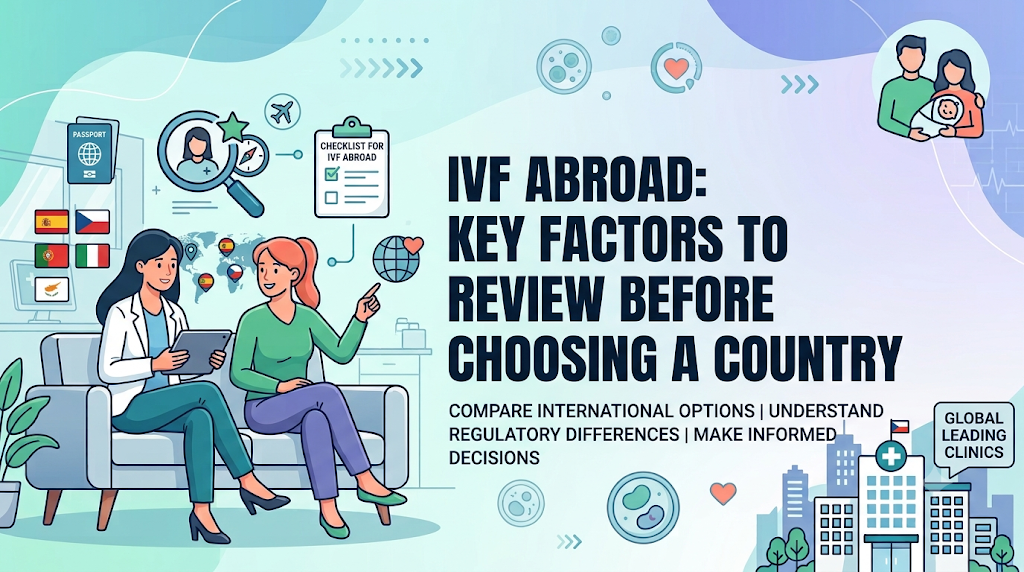
Some patients choose to explore medical care outside their home country for reasons related to cost, treatment availability, or local regulations. Researching IVF abroad involves examining additional logistics, such as travel arrangements, language differences, local legal requirements, and how follow-up care will be managed upon returning home. Ensuring that medical records transfer smoothly and that a local doctor can coordinate subsequent steps is essential for maintaining treatment continuity and safety.
Understanding IVF Cost by Country
Fertility care expenses can look very different around the world, which is why patients often examine IVF cost by country. Price variations are influenced by local healthcare systems, operating expenses, medication pricing, laboratory supply costs, regulatory fees, and currency exchange rates. While international averages can provide a general idea of what to expect, a country-level average does not represent what an individual patient will ultimately pay, as personal treatment requirements always dictate the final expenses.
Egg Freezing and Fertility Planning
Egg freezing involves collecting a person’s eggs, freezing them at very low temperatures, and storing them for potential future use. Individuals often research this option to preserve fertility for personal or medical reasons. The process shares initial steps with standard fertility treatments, including ovarian stimulation and egg retrieval, followed by cryopreservation in a specialized laboratory. While this technology offers options for future family planning, frozen eggs do not guarantee a future pregnancy, and success rates depend heavily on the age at which the eggs were frozen and individual health factors.
Understanding ICSI Treatment
Intracytoplasmic sperm injection, commonly referred to as ICSI treatment, is a specialized laboratory procedure used alongside standard fertilization methods. During traditional fertilization, sperm are placed near an egg in a dish to let fertilization happen naturally. In contrast, ICSI involves a embryologist selecting a single, healthy sperm and injecting it directly into the center of the egg. This approach is often considered when there are specific male-factor fertility considerations or previous fertilization challenges, though a qualified specialist determines whether it is appropriate for a given medical situation.
Exploring Fertility Treatment Options
Assisted reproductive care encompasses a diverse range of medical pathways beyond standard procedures. Available fertility treatment options can range from initial fertility testing and medication-based cycles to intrauterine insemination, conventional IVF, ICSI, embryo transfer, and egg freezing. Each approach serves a different medical purpose, and the most suitable path depends entirely on diagnostic findings, underlying health conditions, and professional medical advice.
Using Information Before Choosing a Provider
Educational research is most effective when used as preparation before speaking with a medical professional. By learning basic terminology, understanding potential costs, reviewing outcome data, and checking provider verification ahead of time, patients can formulate specific questions. Bringing these researched findings to a consultation helps individuals have more productive conversations with qualified specialists regarding their personal care plan.
Practical Research Process
- Understand the fertility concern and available treatment categories.
- Research treatment, testing, cost, and outcome information.
- Shortlist relevant providers using transparent information.
- Compare important factors rather than relying on one number.
- Discuss the findings and treatment choices with a qualified fertility specialist.
Common Research Mistakes
- Comparing prices without verifying what services, tests, and medications are included in the quoted fee.
- Treating a single success-rate percentage as a guarantee of a successful personal outcome.
- Choosing a healthcare provider solely because of an online ranking or high advertising visibility.
- Ignoring provider verification status and background transparency.
- Comparing international treatment costs without factoring in travel logistics, regulations, and follow-up care.
- Assuming the lowest-priced option will result in the lowest overall cost across all cycles.
- Assuming that a specific treatment protocol will work the exact same way for every patient.
- Relying on outdated, unsourced, or purely promotional fertility information.
Realistic Example
As a hypothetical example, a couple researching family-building options might begin by examining treatment expenses across different regions. They notice that one clinic provides a seemingly lower price quote, while another lists a higher amount. Upon closer inspection, they discover that the first quote excludes necessary medications and laboratory monitoring fees, whereas the second quote includes a more comprehensive service package. Instead of choosing based on the initial numbers alone, they review what each package contains, check provider verification details, examine outcome reporting methods, and bring these structured notes to a consultation with a fertility specialist to determine the best path forward.
Useful Comparison Table
| Research Factor | What to Check | Why It Matters |
| Treatment Cost | What services, medications, and lab fees are included | Prevents unexpected expenses and allows accurate comparison |
| Success-Rate Reporting | Patient demographics, age groups, and cycle definitions | Provides accurate context behind statistical percentages |
| Provider Verification | Credentials, licensing, and background transparency | Ensures safety and adherence to professional standards |
| Treatment Availability | Offered technologies and specialized care protocols | Confirms whether a provider matches specific medical needs |
| Follow-Up Care | Continuity of care and local post-treatment support | Maintains safety and proper health monitoring over time |
Frequently Asked Questions
What factors affect IVF treatment cost?
Total expenses are influenced by diagnostic testing, prescribed hormone medications, laboratory procedures, specialized embryo services, clinic pricing structures, and geographic location.
How should IVF success rates be interpreted?
Success metrics should be viewed in the context of patient age, underlying health factors, the number of treatment cycles, and whether the statistics measure pregnancies or live births.
What should I check when researching IVF clinics?
Patients should review provider verification, staff credentials, laboratory standards, transparent pricing details, and available treatment services.
How can patients compare fertility clinics?
Comparison should be based on multiple balanced factors, such as service offerings, specialist qualifications, verified credentials, and clear outcome reporting rather than single rankings.
What should be considered before researching IVF abroad?
Patients looking outside their home country must examine travel logistics, regulatory differences, language barriers, clinic verification, and how follow-up medical care will be coordinated.
Why does IVF cost by country vary?
Price differences across countries stem from local operating expenses, healthcare system structures, medication pricing, taxation, and currency exchange rates.
What is egg freezing?
Egg freezing is a preservation process where a person’s eggs are retrieved and frozen for potential future use, though future pregnancy success depends on age and individual circumstances.
What is ICSI treatment?
ICSI treatment is a laboratory procedure where a single sperm is injected directly into an egg to assist with fertilization during the IVF process.
What are the main fertility treatment options?
Options range from diagnostic testing and medication cycles to intrauterine insemination, conventional IVF, ICSI, and egg freezing, depending on individual medical needs.
Does a higher success rate guarantee a successful IVF outcome?
No statistic can guarantee an individual outcome, as success depends entirely on personal medical characteristics and clinical circumstances.
Conclusion
Navigating fertility care requires careful research, patience, and realistic expectations. By understanding treatment processes, evaluating costs transparently, interpreting success metrics correctly, and comparing providers across multiple factual factors, individuals and couples can prepare thoroughly for their healthcare journey. Platforms like IVFHospitalsNow provide the educational foundation and research tools necessary to explore these choices responsibly. Ultimately, all medical decisions, treatment paths, and personal care strategies should be discussed thoroughly with qualified fertility specialists.
Leave a Reply