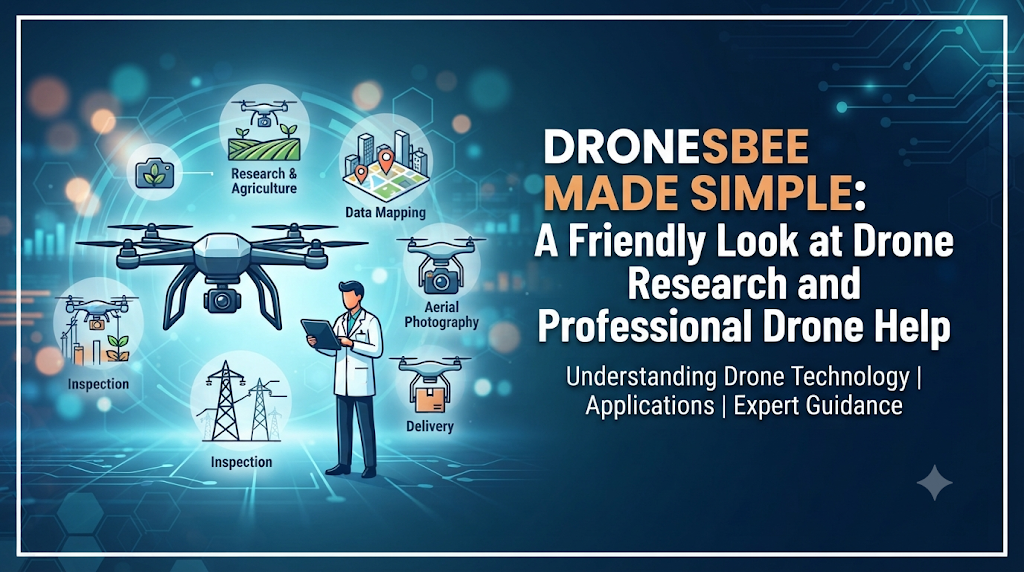
DronesBee Made Simple: A Friendly Look at Drone Research and Professional Drone Help
Introduction
Ask three friends which drone to buy and you may hear three answers. One says camera. One says battery life. One just says brand. They might all be right, but only for their own needs.
Drones have grown into many shapes and jobs. Some film holidays. Some map land. Some check machines, and others watch over fields. Each one carries different sensors, different payload limits, and a different price. Even reading drone specifications can feel like learning a new language. And searching for the best drones without a clear goal often leaves people more confused than before.
Then there is a second question. Should you buy at all, or hire someone who already knows what they are doing? DronesBee is a drone and UAV platform built around both questions. This article walks through how it works and how to think about your own choice.
What Is DronesBee?
DronesBee is an online platform for everything around drones and UAVs. UAV stands for unmanned aerial vehicle, which is just the formal name for a drone.
Think of it as a busy meeting point. On one side, there is plenty to read and research. On the other side, there are people and businesses who fly drones for a living.
Here is what it brings together:
- A drone database with models from DJI, Autel Robotics, Skydio, Parrot, AeroVironment, and other makers
- Product details and drone reviews
- Service discovery, including operator directories
- Drone industry news and UAV technology updates
- Regulation information
- Forums and community spaces
- Learning material for beginners and experts
So it covers two big jobs. It helps you understand and compare drones. And it helps you find professional drone skills when you need them.
Meet the People Who Use It
Different visitors show up with different goals. Here is a peek at what each one wants.
Someone buying their first drone wants something simple. They ask whether it is easy to fly, easy to carry, and good enough for travel clips.
A drone fan loves the details. They follow new models, read about technology, and chat with others in forums.
A professional pilot thinks about daily work. They want a tool that is reliable, works with the right sensors, and does not waste their time.
A commercial operator looks at the bigger picture. Fleet needs, training, safety routines, and rule changes matter to them.
A business owner might know nothing about drones. They just know they want a good result, whether that is property visuals or a site record.
A researcher studies where UAV technology is heading and how different platforms compare.
An industry professional uses news, product details, and regulation updates to stay informed in their own field.
Doing Your Homework on Drones
Smart buyers learn before they spend. The research side of the platform helps with that, layer by layer.
Start with models and makers. Seeing what each brand offers gives you a feel for the market.
Move on to categories. A palm-sized camera drone and a heavy industrial drone are very different creatures, even though both are called drones.
Next, read the drone specifications. These are the plain facts: flight time, range, weight, camera ability, sensors, and payload. If a drone were a car, this would be the engine size, the fuel tank, and the boot space.
Then see what real people say. Drone reviews add the lived experience. Owners may describe how the drone behaves in wind, how easy the app is, and what annoyed them after a month.
When you have a few favorites, try a drone comparison. Put them side by side and notice where each one is strong or weak.
Finally, look at professional and industrial models if your work is demanding.
Here is the key idea. A drone that is wonderful for one person can be a bad choice for another. The right question is never “Is it good?” It is “Is it good for my job?”
Picking a Drone Without Second-Guessing Yourself
Try thinking in questions. Answer each one, and your shortlist will almost build itself.
What will you do with it? Say it in one sentence. This anchors everything else.
What kind of pictures do you want? Travel videos, clean property photos, and technical images are not the same thing.
How long do you need to fly? Longer is usually better, but wind and heavy loads shorten flights in real life.
How far will it go? This matters most over wide areas.
Does it need to carry anything extra? If yes, look closely at payload.
Which sensors matter? For mapping, inspections, and crop work, the sensor can be more important than the camera.
Will you carry it around? A heavy drone may stay at home.
What is your weather like? Wind, rain, and temperature all change the flying experience.
Do you like the software? A smooth app can make a big difference.
What do local rules say? Regulations change from place to place and may depend on the drone.
What will it really cost? Batteries, spare parts, and storage add up.
Who helps if something breaks? Think about repairs and support.
Lots of people hunt for lists of the best drones. But a list cannot know your job. The best option is the one that matches your needs, your skill, and your budget.
Quick Picks by What You Care About Most
| If Your Priority Is | Look Closely At |
|---|---|
| Keeping costs low | Total cost, including batteries and spare parts |
| Long flights | Flight time, and how wind and load affect it |
| Travelling light | Size, weight, and how it packs |
| Windy or wet places | What weather the drone can handle |
| Special tasks | Sensors, payload, and software support |
What Happens When You Hire a Drone Pilot
Not everyone should own a drone. If a task is rare, technical, or risky, a skilled pilot may be the smarter choice.
Drone services are paid jobs done by trained operators for individuals and businesses. The clients can be real estate sellers, film crews, builders, farmers, infrastructure managers, and teams that watch over the environment. The work may be about photos, surveying, inspection, or field monitoring.
A typical job looks like this. First, you tell the pilot what you need. The pilot checks the location, the weather, and the rules. Next, they choose the right drone and equipment. They plan the flight with safety in mind. After the flight, they deliver what was agreed, such as images, video, data, or a report.
The pilot’s flying ability is just one piece. The equipment, the safety habits, and a solid understanding of your project all count. That is why no single pilot fits every job.
DronesBee connects users with qualified operators and professional services, so your search has a starting place.
Real Places Where Drones Earn Their Keep
Making a Place Look Its Best
Aerial photography services help show places from angles that ground cameras cannot reach. Real estate sellers use them to show a house with its surroundings. Filmmakers use them to capture sweeping scenes. Builders record how a site changes over time. Tourism teams share views that make people want to visit.
A good result needs planning, good light, and a pilot who knows how to frame a shot.
Getting the Numbers Right
Drone surveying services help gather information about land and building sites. A drone can cover a big area quicker than people on foot. That data can help with land surveys, mapping, planning construction, and measuring sites.
Accuracy is the heart of the job. A careful plan and the right tools make a real difference.
Seeing What’s Hard to See
Drone inspection services are helpful when a place is high, narrow, or unsafe. Think of roofs, towers, bridges, industrial equipment, and large building sites. The drone flies close and records what it sees, so nobody has to climb to take a look.
The pilot still needs to know what to look for. Good sensors and steady flying help too.
Keeping an Eye on the Crops
Agricultural drone services help with monitoring fields. From above, a farmer gets a bigger picture of the land. Patches that look different can stand out, and that helps decide where to check on the ground. What is possible depends on the drone and its sensors, so it pays to match the service to your actual question.
Looking for Someone Nearby?
Many people search for “drone pilots near me”. It is a natural move. A local pilot can reach your site easily and often knows how the area’s weather and rules work.
Before you choose, ask yourself:
- Has this pilot done work like mine?
- What drone and equipment will they use?
- How do they handle safety?
- Do they know the local rules?
- What will I receive when the job is done?
What You Usually Get at the End
| Type of Job | What You Commonly Receive |
|---|---|
| Aerial photos and video | Edited images or video clips |
| Land surveying and mapping | Maps and measurement data |
| Inspections | Images, video, and notes on what was found |
| Field monitoring | Field images and observations |
Always confirm the exact format with the pilot before the job starts.
Five Steps to Make Up Your Mind
Step 1: Figure Out What You Want
Begin with the end result. A video? A site map? A report? A drone for weekend fun? When the goal is clear, everything after it is easier.
Step 2: Do You Need a Drone or a Pilot?
If you will fly often, owning a drone may make sense. If the job is rare or technical, hiring may be smarter. Take a moment with this one. It affects your time, money, and stress.
Step 3: Weigh Up the Choices
Now compare. For drones, look at specifications, features, and feedback from owners. For pilots, look at their experience, their equipment, and what they will deliver. Keep checking each option against your goal.
Step 4: Look Closely Before You Commit
Before saying yes, verify the details. For a drone, check support, what is included, and the rules in your area. For a pilot, ask for earlier work, learn about their safety habits, and confirm the final delivery.
Step 5: Go With What Suits Your Project
A famous name is not always the right answer. Choose the drone or service that fits your project, your timeline, and your budget.
Easy Mistakes, and How to Dodge Them
Following the crowd. A drone that many people own may not fit your job. Check your needs first.
Looking at price only. A cheap option can cost more later if it falls short.
Skipping the specifications. They tell you what a drone can really do.
Comparing drones without a purpose. Comparisons only make sense once you know the job.
Hiring without checking experience. Being good at one thing does not always mean being good at another.
Ignoring local rules. Rules differ between places. Missing them can cause delays or fines.
Expecting one drone to do it all. Different jobs need different tools.
Forgetting upkeep and safety. Batteries wear out and parts break. Plan for care and safe flying from the start.
A Little Story to Show How It Works
Meera volunteers for a small conservation group in an imaginary town. The group wants to watch how a riverbank changes over the seasons. They also want a clear map of the shoreline and some photos to share with supporters.
First, Meera figures out what the group wants. There are three things: regular photos, a map, and a record of changes over time.
Second, she asks whether to buy or hire. Because the group needs to fly often, buying a small drone makes sense. But the first shoreline map is a special task. She decides to ask a local pilot for help with it.
Third, she weighs up the choices. For the drone, she reads drone reviews and checks flight time, camera details, and how easy it is to carry. For the pilot, she asks about mapping experience and what the group will receive.
Fourth, she looks closely. She checks local flying rules near the river, asks the pilot for earlier examples, and confirms what support comes with the drone.
Fifth, she goes with what suits the project. The group buys a simple drone for regular photos, and the pilot handles the first map and shows the volunteers how to fly safely.
Nobody picked the most famous name. They chose what matched their work.
FAQ
1. Does DronesBee only cover famous brands?
No. Along with well-known names like DJI, Autel Robotics, Skydio, Parrot, and AeroVironment, the database also includes products from other drone manufacturers.
2. Is it worth reading forums before buying a drone?
Yes, it can help. Forums let you see what real users talk about, such as common problems, helpful tips, and how drones perform in daily use.
3. What if two drones have nearly the same specifications?
Look at the things numbers do not show. Read owner feedback, check the software, and think about support and size. Also ask which one suits your actual job better.
4. Are drone services only for big companies?
No. Individuals can use them too. A home seller or a small group may just need photos or a map, and a hired pilot can handle that.
5. How do I know whether I need photos, a map, or an inspection?
Think about the final result. If you need visuals to show a place, choose photography. If you need measurements, choose surveying. If you need to check the condition of something, choose inspection.
6. Do drones replace people in inspections completely?
Not usually. Drones help people get a safer, closer first look, but trained people still study the results and make decisions.
7. Can environmental groups use drones?
Yes. Environmental monitoring is one of the areas where drone work is used, such as watching how a shoreline or a natural site changes over time.
8. Why does a pilot ask so many questions before a job?
Because good planning depends on the details. The location, weather, rules, and your goal all affect how the flight should be done.
9. How often should I check for changes in the rules?
It is wise to check before every new project and any time you plan to fly somewhere new, since regulations can change and differ by place.
Conclusion
The drone world has two sides, and DronesBee covers both. One side is about research: learning about models, reading drone specifications, and choosing a product. The other is about professional help: finding qualified operators and understanding the services they offer.
Whichever path you take, a few habits always help. Know what you want. Learn what a drone can and cannot do. Think about where it will fly and what the weather is like. Look at the experience and safety habits of any pilot you hire. Follow the local rules. And count the full cost.
A drone is a tool, nothing more. It does its best work when it fits the job, and a little good research is how you make sure it does.
Leave a Reply