A Practical Approach to Keeping Reliability Work Sustainable as Systems Grow
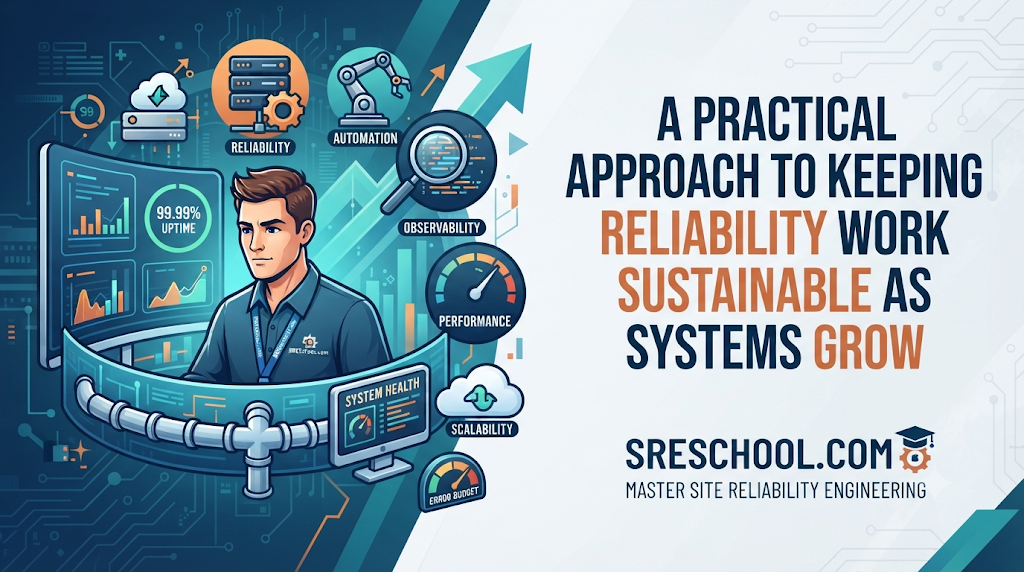
Modern software runs on complex digital systems. When a mobile app crashes or a website fails to load during a big sale, users get upset, and businesses lose money. Keeping these systems running smoothly is the job of Site Reliability Engineering, or SRE.
At its core, SRE combines software writing with daily system operations. Learning platforms like SRESchool.com help engineers and teams learn how to design, build, and maintain dependable production environments. This guide explains how reliability practices work, why they matter, and how structured learning helps teams master production systems in simple terms.
What Is Site Reliability Engineering?
Site Reliability Engineering started because old operations work could not keep up with fast-moving software growth. In the past, developers wrote code and handed it over to a separate team to run on servers. If something broke, the operations team fixed it by hand.
SRE changes this approach. Instead of fixing production issues manually every time they happen, reliability engineers write code and automation scripts to stop failures before they start.
A reliable system keeps working even when parts of it break. It gives fast responses, handles busy traffic without slowing down, and protects user data. Getting to this point takes careful planning, good visibility, and constant measurement.
Why Reliability Matters
Today’s computer systems are rarely simple. They rely on cloud servers, external tools, shared databases, and thousands of small services running in different places.
When one small part fails, it can cause a chain reaction that breaks an entire platform. Common problems include:
- Downtime: Users cannot reach the service at all.
- Slow Speed: Pages load very slowly, making the app frustrating to use.
- Alert Fatigue: Monitoring systems send too many false alarms, causing teams to miss real emergencies.
- Manual Work: Engineers spend hours doing repetitive tasks instead of building new features.
Waiting for systems to break and fixing them afterward is stressful and expensive. Good reliability practices help teams spot small warning signs before they turn into major outages.
Understanding SRESchool.com and Learning Resources
As software systems grow more complicated, professionals need trusted places to learn advanced operational skills. SRESchool.com is a specialized global platform focused entirely on Site Reliability Engineering. It helps engineers and organizations learn how to build systems that stay online, scale smoothly, and recover quickly from errors.
The platform provides learning resources across several key areas:
- SRE Training: Practical learning around error budgets, monitoring, and incident response.
- SRE Certification: Structured tests to check professional knowledge.
- Site Reliability Engineering Course: Complete study paths for cloud, DevOps, and platform engineers.
- SRE Consulting: Expert advice to help companies check and improve their reliability practices.
- SRE as a Service: Ongoing operational support for cloud infrastructure and production platforms.
- Corporate SRE Training: Custom learning programs for enterprise engineering teams.
- SRE Tutorials and Tools: Step-by-step guides and technology overviews for modern monitoring and automation.
Core Reliability Concepts: SLI, SLO, and Error Budgets
To manage reliability, teams cannot just guess if a system is healthy. They need clear measurements.
Service-Level Indicators (SLIs)
An SLI measures how well a system is performing. It is usually shown as a percentage. A common example is the percentage of successful web requests.
Service-Level Objectives (SLOs)
An SLO sets the target goal for an SLI. For example, a team might set a goal that 99.9% of all user login requests must work within two seconds.
Error Budgets
An error budget is the amount of unreliability a service is allowed to have within a certain time. If an SLO is 99.9% uptime, the error budget is 0.1%.
This budget helps teams balance speed and stability. If the error budget is healthy, developers can release new features quickly. If the budget runs out because of too many outages, the team must pause new features and focus entirely on fixing reliability problems.
Monitoring Versus Observability
Many people confuse monitoring with observability, but they do different jobs.
- Monitoring tells you when a system is broken. It collects basic numbers and sends an alert when a limit is crossed, like when CPU usage hits 90%.
- Observability helps you understand why the system broke. It combines numbers, logs, and traces to let engineers inspect the inside of a complex system.
Collecting data is not enough. Engineers must also understand what the data tells them about application behavior.
Managing Incidents and Learning from Failure
Even with great planning, outages still happen. A simple incident response process helps teams fix problems fast:
- Detection: The monitoring system spots a problem, or a user reports it.
- Triage: Engineers check how bad the issue is and who is affected.
- Investigation: The team looks at logs, metrics, and recent updates to find the cause.
- Recovery: A fix is applied, like rolling back a bad update or restarting a server.
- Post-Mortem Review: The team talks about what happened and how to stop it next time—focusing on fixing the system rather than blaming people.
Automation and Reducing Repetitive Work
Manual work that is repetitive and adds little lasting value is known as toil. If engineers spend all their time resetting passwords or restarting crashed servers by hand, they have no time for real engineering work.
SRE focuses heavily on automation. By writing scripts and building pipelines, teams can automate deployments, scaling, and routine recovery tasks. However, automation must be tested carefully. Badly written scripts can sometimes cause bigger problems than manual mistakes.
Step-by-Step Learning Path
Whether you are studying through a Site Reliability Engineering Course or preparing to become a Certified Site Reliability Engineer, a step-by-step learning path builds strong skills:
- Operations Basics: Learn how Linux, networks, and basic cloud servers work.
- Monitoring Basics: Learn how to collect system numbers and set up basic health checks.
- SLIs and SLOs: Learn how to measure user experience and set realistic goals.
- Observability: Study logs, metrics, and tracing tools.
- Incident Management: Practice quick problem solving and team communication.
- Automation: Learn how to replace repetitive manual tasks with code.
- Capacity Planning: Study how traffic growth impacts computer resources.
- Cloud Reliability: Explore multi-region setups and disaster recovery.
Who Benefits from SRESchool.com?
Reliability practices help many different technical roles:
- Students and Beginners: Build a strong foundation in modern production systems.
- Software Engineers: Learn how code behaves in real production environments.
- DevOps and Cloud Engineers: Connect deployment pipelines with reliability monitoring.
- Platform Engineers: Design scalable and stable infrastructure.
- Engineering Leaders: Align team goals with business uptime needs.
- Organizations: Build mature SRE practices across company tech stacks.
Common SRE Mistakes to Avoid
Even experienced teams make mistakes when starting with SRE. Avoiding these traps helps ensure success:
- Learning Tools Before Concepts: Buying expensive software before understanding what metrics matter.
- Setting Unrealistic SLOs: Promising 100% uptime, which is nearly impossible in the cloud.
- Ignoring Software: Treating SRE as purely an old-school operations job instead of writing automation code.
- Blaming People: Punishing individuals during outages instead of fixing fragile system processes.
Conclusion
Site Reliability Engineering is essential for building dependable software. By combining clear goals, thoughtful automation, and continuous learning through platforms like SRESchool.com, engineers can manage complex production systems. Reliability is an ongoing practice of learning from failure and making systems stronger over time.
Frequently Asked Questions
What is Site Reliability Engineering?
Site Reliability Engineering applies software engineering to IT operations, helping organizations build scalable and dependable software systems.
What is SRE training?
SRE training is structured learning that teaches engineers core reliability practices like setting SLOs, managing incidents, and reducing manual toil.
What does an SRE certification prove?
An SRE certification shows that a professional understands core reliability concepts, monitoring tools, and production engineering best practices.
What topics are covered in an SRE course?
A complete course covers reliability basics, SLIs, SLOs, error budgets, observability, incident management, automation, and cloud architecture.
What is the difference between an SLI and an SLO?
An SLI is the actual metric measured (like request speed), while an SLO is the target goal set for that metric (like 95% of requests finishing fast).
What is an error budget?
An error budget is the total amount of downtime or failure a service can experience before it breaks its reliability goals with users.
How does SRE consulting help?
SRE consulting provides expert external reviews of a company’s reliability maturity, monitoring setups, and incident processes.
What is SRE as a Service?
SRE as a Service provides ongoing outsourced reliability and monitoring support for cloud infrastructure and production platforms.
What is corporate SRE training?
Corporate training aligns entire enterprise engineering teams around shared reliability standards and incident response workflows.
Do I need coding skills to learn SRE?
Yes. Because SRE treats operations as a software problem, basic programming and scripting skills are needed to write automation and troubleshoot issues.
Leave a Reply