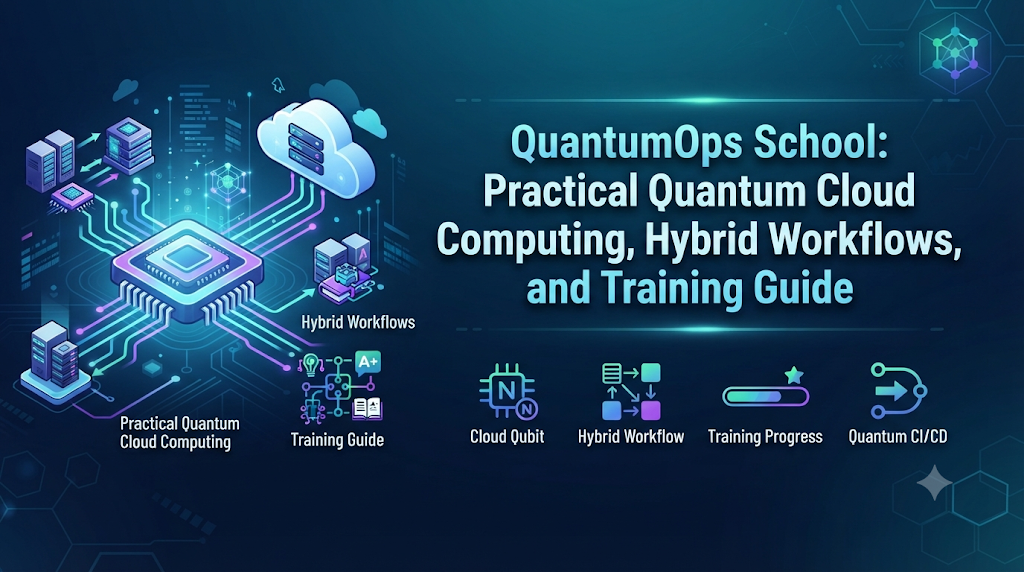
QuantumOps School: Practical Quantum Cloud Computing, Hybrid Workflows, and Training Guide
Introduction
Quantum computing often sounds like science fiction in headlines, yet the real shift happening today is much more practical. Software engineers, cloud architects, and IT leaders are learning how quantum processors connect with everyday cloud systems.
QuantumOps School focuses on that practical bridge. Based in India and offering online and classroom learning options, it connects quantum computing ideas with cloud infrastructure, hybrid quantum-classical workflows, and day-to-day technical operations.
Rather than treating quantum computing as a replacement for regular servers or cloud databases, a grounded approach looks at where quantum circuits help and where classical systems stay faster, cheaper, and simpler.
Why Quantum Cloud Operations Matters Now
Most developers and IT teams do not keep a quantum processor in a server room. Instead, they access quantum hardware and high-powered simulators over the cloud.
That changes how teams work. Writing a quantum circuit is only one step. Engineers also need to manage cloud accounts, pick between local or cloud simulators and real quantum devices, handle queue times and noise, and combine quantum outputs with classical software.
For engineers moving from standard cloud engineering into quantum technologies, hands-on operational habits matter just as much as theory. Knowing how a job travels from a Python script to a cloud queue and back into an application makes quantum concepts much easier to test.
Core Quantum Concepts Made Practical
You do not need a physics doctorate to start learning quantum computing, but a few core ideas behave differently from classical code:
- Classical bits vs. qubits: A classical bit is either
0or1. A qubit is a two-level quantum system described by a quantum state. - Superposition: Before measurement, a qubit can exist in a linear combination of basis states. Measuring it yields a classical outcome (
0or1) with probabilities determined by its state. A qubit does not hold two separate classical bits at once. - Entanglement: Two or more qubits can become correlated so that measuring one gives information about the other, even when separated.
- Quantum gates and circuits: Quantum gates change qubit states, and a sequence of gates forms a quantum circuit.
- Interference: Quantum circuits use phase and interference so helpful answer paths reinforce while unwanted ones cancel out.
- Noise, decoherence, and error correction: Real hardware interacts with its environment, causing noise and decoherence that limit circuit depth. Quantum error correction aims to protect logical qubits across multiple physical qubits, though it remains an active engineering challenge.
Hybrid Quantum-Classical Workflows in Action
In practice, today’s useful quantum experiments rarely run on a quantum device from start to finish. Most rely on hybrid quantum-classical computing.
Here is how a typical hybrid loop works:
- A classical program prepares input parameters and builds a parameterized quantum circuit.
- The workload is sent through a cloud service to a simulator or an available quantum processor.
- The quantum backend runs the circuit and returns measurement counts (shots).
- Classical software reads those results, updates parameters—such as in a variational routine—and decides whether to run another round or stop.
Whether a hybrid workflow helps depends on the problem structure, circuit depth, hardware noise, queue latency, and cost. Classical computers still handle data prep, orchestration, storage, and standard logic.
Example: Building and Simulating a Bell State in Qiskit
The short Python snippet below shows a common starting circuit using Qiskit on a local simulator (qiskit-aer). It creates a two-qubit entangled state and reads out measurement counts.
Python
# Illustrative example using Qiskit and qiskit-aer (local simulation)
from qiskit import QuantumCircuit
from qiskit_aer import AerSimulator

# 1. Build a 2-qubit circuit
qc = QuantumCircuit(2)
qc.h(0)        # Put qubit 0 into superposition
qc.cx(0, 1)    # Entangle qubit 0 (control) and qubit 1 (target)
qc.measure_all()

# 2. Run on a classical simulator
simulator = AerSimulator()
job = simulator.run(qc, shots=1024)
result = job.result()
counts = result.get_counts()

print("Measurement counts:", counts)
In a real cloud workflow, you would test and debug logic on a simulator first, then swap in a cloud hardware target or managed simulator when needed—watching shot counts, execution limits, and noise effects.
Frameworks and Cloud Platforms You Will Encounter
Different toolkits and cloud providers serve different parts of the development stack.
| Tool / Platform | Primary Role | Typical Strengths | Practical Considerations |
| Qiskit | Open-source Python SDK for circuit design and execution | Widely used for learning circuits, local simulation, and IBM Quantum workflows | APIs and provider packages evolve; requires tracking current versions |
| Cirq | Python framework focused on gate-level circuit control | Helpful for inspecting circuits and hardware-aware gate sequences | Best suited to developers comfortable with circuit-level details |
| Microsoft Quantum Development Kit | Quantum development tooling and resources | Supports quantum programming workflows and learning materials | Check current documentation for supported languages and cloud setup |
| AWS Braket | Managed cloud quantum service | Lets teams build workflows and run jobs on simulators or supported QPUs | Requires AWS account governance, IAM controls, and job cost tracking |
| IBM Quantum | Cloud access to quantum systems and tools | Connects Python circuit code with cloud simulators and quantum hardware | Queue times, calibration differences, and noise affect real runs |
| Azure Quantum | Cloud ecosystem for quantum tools and services | Fits organizations already standardizing on Microsoft cloud identity and billing | Verify current regional availability and supported targets |
Simulators are essential early on. They let engineers test logic fast without waiting in hardware queues or spending limited device time on basic syntax bugs.
Learning Paths, Training Tracks, and Consulting
QuantumOps School structures its advertised training and certification around four tracks—QuantumOps Architect, QuantumOps Engineer, QuantumOps Manager, and QuantumOps Professional—using instructor-led sessions, practical labs, simulations, case studies, technical assessments, and capstone projects.
A practical way to match learning to your role is:
- Software developers benefit from Python fluency, basic probability and linear algebra, circuit construction, simulator testing, and connecting classical apps to cloud quantum APIs. You do not need to become a quantum researcher to write and test circuits.
- Cloud engineers focus on identity and access controls, cloud resource management, job submission, monitoring, cost awareness, and hybrid orchestration.
- System architects examine quantum hardware limits, classical control and orchestration layers, error correction concepts, and hybrid system boundaries.
- IT managers look at realistic use cases, technical feasibility, team readiness, security policies, budget planning, and phased experimentation rather than instant full-scale replacement.
Beyond training, QuantumOps School promotes quantum computing consulting services—such as readiness assessments, cloud integration, algorithm and workload work, hybrid architecture, security planning, and mentoring—pointing to potential exploration areas like finance, healthcare, pharmaceuticals, research, logistics, and software. Note that these describe advertised capabilities and potential exploration areas rather than independently verified project outcomes, and advertised credentials are provider credentials rather than independently accredited or government-recognized qualifications.
Adoption Limits and Realistic Expectations
Good technical planning means setting clear boundaries early:
- No blanket speedup: Quantum processors do not speed up every database query, web API, or spreadsheet task.
- Hardware constraints: Qubit counts, connectivity, gate fidelity, and decoherence still shape what circuits can run reliably today.
- Encryption clarity: Claims about breaking current encryption often outpace near-term hardware; treat post-quantum cryptography as its own dedicated security planning track.
- Phased start: Start with small experiments, clear success metrics, and strong classical engineering foundations.
Frequently Asked Questions
1. Do I need a strong math background before starting a Qiskit programming course?
Basic comfort with Python, simple fractions or probabilities, and introductory vectors or matrices is enough to start building basic circuits and running simulator experiments.
2. When should an engineer use AWS Braket training or cloud quantum access instead of a local simulator?
Start on a local simulator while learning gates and debugging logic. Move to cloud simulators or hardware targets when you want to test managed cloud job workflows, IAM and billing controls, or real hardware behavior.
3. How does a quantum computing architecture course help system architects?
It clarifies how classical control and orchestration software, simulators, cloud APIs, and quantum processors fit together—and where noise and hardware limits shape system design.
4. What should IT managers prioritize when exploring quantum computing consulting services?
Focus first on problem fit, team training, security and access governance, cost control, and small proof-of-concept experiments tied to clear learning goals.
5. Is QuantumOps certification an accredited academic or government degree?
No. Like vendor or training-provider credentials in specialized tech fields, it is an advertised professional credential from the training provider rather than an independently accredited or government-recognized qualification.
Conclusion
Quantum computing becomes far easier to evaluate when you treat it as an extension of modern cloud and software engineering rather than a magic shortcut. Learning core concepts, practicing with simulators and frameworks like Qiskit or AWS Braket, and understanding hybrid workflows help technical teams separate hype from real capability. Whether you are building skills through structured training tracks or planning early experiments, steady, practical engineering is the safest way forward.
Leave a Reply