Essential Indonesian Words for Renting a Vehicle with Confidence
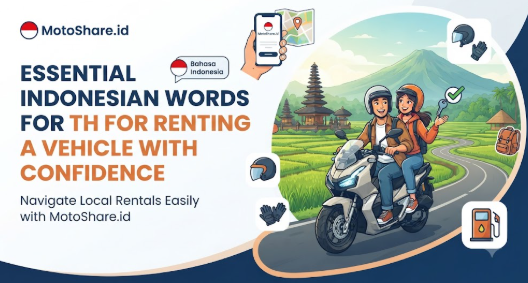
Picture a traveller scrolling through rental listings in Indonesia. One says “lepas kunci.” Another asks for a “jaminan.” A third mentions “SIM C.” Each listing looks different, but they are all saying something important about the rental.
You do not need to speak Indonesian to rent a vehicle. But a few key words make listings, signs, and conversations with providers much easier to understand. This guide explains those words in plain English and shows how they connect to real decisions about price, documents, and safety. It also explains how MotoShare, an online vehicle-rental marketplace, fits into the process, and covers Bali, Jakarta, and Lombok along the way. It is general guidance, so confirm the details of your own rental with the provider and the relevant Indonesian authorities.
What MotoShare Does
MotoShare is an Indonesia-focused online marketplace for vehicle rentals. A marketplace connects two groups: local vehicle providers who list their vehicles, and renters who browse and choose.
According to its description, MotoShare serves international tourists, local travellers, backpackers, digital nomads, students, professionals, and commuters. The vehicles include scooters, motorcycles, premium bikes, adventure motorcycles, and cars. The description also mentions flexible rental periods, online booking, transparent pricing, verified providers, and travel guides.
Every rental passes through three stages:
- Search: Choose a location and dates and see what is available.
- Compare: Read the price, the rental length, and the terms of each listing.
- Confirm: Book only when you understand the full agreement.
Language matters most in the compare stage, when you read the listing and the terms. Availability also depends on the location and dates, so read each listing as belonging to its own place.
Why Different Travellers Need Different Words
The words you meet depend on what you rent.
- A tourist may mostly meet scooter and helmet words.
- A commuter may meet monthly-rental and fuel words.
- A family may meet car and driver words.
- An experienced rider may meet words for bigger motorcycles.
- A careful planner may meet them all while comparing options.
The right vehicle depends on the destination, journey length, budget, experience, comfort, and local requirements. Knowing the words helps you compare listings with confidence.
Core Words for Vehicles
Sewa
“Sewa” means “to rent.” You will see it in signs, listings, and messages. “Saya mau sewa mobil” means “I want to rent a car.”
Motor and sepeda motor
“Motor” is the everyday word for a motorcycle or scooter. The fuller form is “sepeda motor,” which language lessons translate as scooter, moped, or motorcycle. “Sepeda” on its own means bicycle, so do not confuse the two.
Mobil
“Mobil” means car.
Moge
“Moge” is short for “motor gede,” which means “big motorcycle.” Indonesian motoring sources use it for larger motorcycles.
These words explain why a search may use different phrases. Someone may type sewa motor Bali for a scooter or motorcycle in Bali. Someone else may type sewa motor Jakarta for a similar rental in the capital. Both simply mean renting a motorbike. Listings in English may use “scooter,” “bike,” or “motorcycle,” so read each description carefully.
Words About How You Rent
Lepas kunci
Indonesian sources use “lepas kunci” for renting a car without a driver, which means self-drive. It is often contrasted with renting “dengan sopir,” which means with a driver. If you are exploring self drive car rental Indonesia, “lepas kunci” is the phrase to look for on Indonesian-language listings.
Sopir or supir
This means driver. “Tanpa sopir” means without a driver.
Jaminan
“Jaminan” means a guarantee or security. In rentals, it can refer to something the provider holds until you return the vehicle, such as a deposit or an item of value. Indonesian sources describe providers asking for identity documents, a licence, or other items as security. Practices vary, so ask exactly what is being held, in what form, and how and when it is returned. Think carefully before handing over original important documents, and ask whether there is another option.
Kapan harus dikembalikan?
This phrase means “When must it be returned?” It is a handy question to ask, because the return time can affect your cost.
Words About Documents
SIM
“SIM” is the Indonesian driving licence. Indonesian sources refer to “SIM A” for cars and “SIM C” for motorcycles. International visitors do not usually hold these.
IDP
For international visitors, travel and motoring sources say you should carry your home licence together with an International Driving Permit (IDP) for the right vehicle class, such as a motorcycle or car. An IDP is a standard translation of a licence. It does not replace your home licence, and it is not an Indonesian licence. The class of licence you hold at home matters too, because a car licence does not automatically cover a motorcycle. Riding or driving without the right documents can also affect your travel insurance after an accident.
KTP and STNK
“KTP” is the Indonesian identity card. “STNK” refers to a vehicle’s registration papers. You may hear these mentioned in local rental talk, especially by Indonesian renters, but visitors should simply ask what the provider requires.
Rules and enforcement can change. Confirm current requirements with the Indonesian authorities or your provider.
Understanding the Vehicle Types
A “two-wheeler” is any vehicle with two wheels. Here is how the common kinds compare.
- Scooters: They have a flat footrest and a step-through frame. They are light and easy to park. Newer riders often find them approachable, though practice and proper licensing still matter.
- Commuter motorcycles: These are made for daily use and are usually simple and economical.
- Sports bikes: These are fast and sharp. They suit experienced riders better than crowded streets.
- Premium motorcycles: These are higher-end, often more comfortable and powerful, and usually cost more.
- Adventure motorcycles: These are built for long distances and mixed roads, and they are often tall and heavy.
No type is best for everyone. Rider experience, road conditions, passengers, luggage, and distance all matter.
Putting the Words to Work by Place
In Bali
Many visitors begin with scooter rental Bali in mind, because a small scooter can suit short trips between nearby places. Conditions differ across the island:
- Kuta and Seminyak: busy, with heavy traffic and tight parking
- Canggu: narrow streets and many cafés
- Ubud: village roads and many pedestrians
- Sanur: often calmer
- Uluwatu: hills, bends, and cliff roads
- Denpasar: the capital, with full city traffic
Weather, parking, and local rules differ by area. When you compare listings, check availability for your dates, the total price for your stay, the pickup place, and the provider’s terms. Do not assume a certain model is available in a certain town.
In Jakarta
Jakarta is a very large city with dense traffic. Residents and visitors who need transport for several weeks or months sometimes look for bike rental Jakarta. Rental length, vehicle type, pickup and return places, total cost, and provider rules all matter. Smaller machines may handle congestion more easily. If heavy traffic is outside your comfort zone, think honestly about whether a car or another form of transport suits you better.
In Lombok
Lombok is quieter than Bali. Travellers who search for scooter rental Lombok often plan short trips between beaches, towns, and viewpoints. A quieter island still calls for planning:
- Distance: Measure each leg of your route.
- Weather: Rain makes roads slippery.
- Road surface: Quality varies.
- Fuel: Refuel before remote stretches. The word for petrol is “bensin.”
- Stops: Know where you can rest and find help.
- Daylight: Unfamiliar roads are usually easier by day.
Across the Country
Many travellers look for motorcycle rental Indonesia, whether for a short visit, a long stay, or a longer journey. A listing in one city does not mean a vehicle is available elsewhere. The same goes for bike rental Indonesia, where “bike” can mean a motorcycle, a scooter, or a bicycle. Read each listing closely and check the vehicle type, pickup place, and dates. Requirements can also differ between motorcycles, scooters, bicycles, and cars.
If you plan to move between islands, ask whether the vehicle may travel with you. Many rentals are meant to stay on one island.
For Longer Motorcycle Journeys
Those looking for adventure motorcycle rental Indonesia are usually planning journeys over mixed roads. Longer rides call for extra care:
- Engine size: More power usually means more weight.
- Comfort: Seat and posture matter over many hours.
- Luggage: Confirm the bike can carry your bags securely.
- Protective gear: Helmet (“helm”), gloves, jacket, and sturdy shoes.
- Weather and surfaces: Rain and rough roads change handling.
- Fuel and rest: Plan refuelling and breaks ahead of time.
A big, powerful bike is not suitable for every rider or route. Choose the one you can control.
When a Car Is the Better Fit
A car can be better for families, groups, business trips, and heavy luggage, and it shelters you from sun and rain. If you are looking at car rental Indonesia, you may see hatchbacks, sedans, and SUVs. A hatchback is compact and easy to park. A sedan has a separate boot. An SUV is taller and roomier. Not every category is available everywhere.
Compare passenger capacity, luggage space, rental length, total cost, insurance, deposit, mileage limits, and fuel policy. In a self-drive rental, you drive the vehicle yourself, subject to applicable law and the provider’s terms. Before booking, confirm:
- That you are permitted to drive that vehicle class in Indonesia
- What the insurance covers and what it excludes
- That the vehicle’s documents are in order
- How the deposit works
- When and where pickup and return take place
Words About Cost
Cost words matter too. Prices in Indonesia are usually shown in Indonesian rupiah (IDR), and terms vary by provider, vehicle, location, and rental length. Look for:
- Harga: the word for price. Check what it includes.
- Jaminan: security or deposit. Ask when it is returned.
- Asuransi: insurance. Ask what is covered and what is excluded.
- Bensin: fuel. Ask what level the tank should be at return.
- Denda: a fine or penalty, for example for late returns.
- Mileage limits: Extra distance may cost extra.
- Damage policy: Learn who pays for scratches and repairs.
- Cancellation terms: Know what happens if plans change.
The advertised daily price rarely tells the whole story, so add up every cost before you confirm.
Staying Safe: Before You Ride Away
- Protective gear: On two wheels, a good, well-fitting helmet is a must. Gloves and sturdy shoes help.
- Vehicle check: Look at the brakes, lights, tyres, mirrors, and horn.
- Existing damage: Photograph every scratch and dent before leaving.
- Local rules: Learn the basics of local traffic rules, which may differ from home.
- Documents: Carry your licence, permit, and rental papers.
- Emergency contacts: Save the provider’s number and local emergency numbers.
- Final check: Reconfirm licensing, insurance, and rental requirements.
No road is safe for every rider. Choose routes that suit your skill, and slow down when conditions are unclear.
A Five-Step Planning Process
This is general advice and not a description of any specific booking system.
- Choose destination, dates, and vehicle type. Everything else depends on these.
- Compare listings and total costs. The lowest daily rate may not make the lowest total.
- Check driving rules, documents, and terms. Make sure you meet the requirements.
- Review insurance, deposit, pickup, and condition. Surprises here are the most expensive.
- Confirm only when you understand the agreement. Ask questions first.
Common Mistakes
- Choosing a bike that is too hard to handle. Match size and power to your experience.
- Reading only the daily price. Add every cost together.
- Skipping insurance and deposit terms. Read them closely.
- Not confirming pickup and return details. Agree on place and time.
- Assuming a foreign licence is accepted. Check the rules first.
- Not checking for existing damage. Photograph the vehicle at pickup.
- Ignoring weather and roads. Plan for rain and rough surfaces.
- Assuming a vehicle is available. Check the exact dates.
A Hypothetical Example: Mei and Her Mother on Lombok
Mei plans a week on Lombok with her mother. She rides a motorcycle at home, so her first idea is to rent a scooter. As she scrolls through listings, she sees several Indonesian terms and takes a few minutes to look them up.
She notices “lepas kunci” on a car listing and understands it means self-drive. She sees “jaminan” and asks the provider exactly what is held and how it is returned. She learns “bensin” and asks about the fuel level at return. She also asks “Kapan harus dikembalikan?” to confirm the return time.
Then she checks the practical side. Her mother does not ride, and they will carry two suitcases. The forecast shows some rain. She compares a scooter with a car, reading the deposit, insurance, mileage, and fuel terms for both. A car gives space and shelter. She checks the rules too, confirming that her home licence and International Driving Permit cover cars, and that her travel insurance applies.
She chooses a self-drive car. She photographs it at pickup, saves the provider’s number, and agrees on the return details. A few minutes with the vocabulary turned a confusing listing into a clear decision.
Frequently Asked Questions
How can I compare scooter options in Bali?
Check availability for your dates, the full price, the pickup place, the rental length, and the provider’s terms. Remember that traffic differs between areas.
What does “sewa motor” mean?
“Sewa” means “to rent,” and “motor” means motorcycle or scooter, so the phrase means renting a motorbike.
What should I check before renting a motorcycle?
Confirm your licence and permit, review the insurance and deposit terms, and inspect the vehicle.
How can I compare vehicles in Jakarta?
Look at rental length, vehicle type, pickup and return arrangements, total cost, and rules. Consider your comfort with dense traffic.
What should I know before renting a car?
Check passenger and luggage space, insurance, deposit, mileage limits, and fuel policy, and make sure you are permitted to drive it.
What does “lepas kunci” mean?
It refers to renting a car without a driver, which means self-drive.
Which documents should international visitors check?
Check whether you need your home licence plus an International Driving Permit for the correct vehicle class. Confirm with the authorities or your provider.
What should I ask about a “jaminan”?
Ask exactly what is being held, in what form, and how and when it is returned.
Final Thoughts
A few Indonesian words go a long way. “Sewa,” “lepas kunci,” “jaminan,” “bensin,” and “SIM” each point to a real decision about how you rent, what you pay, and what you need to carry. Learning them takes a few minutes and can save a great deal of confusion.
Pick a vehicle that suits your route and skills, check your documents, compare the full cost, and read the terms before you confirm. MotoShare is one place to start searching, comparing options, and thinking through your choices, and a little language makes every listing clearer.
Leave a Reply