Motorcycle Rental Terms and Conditions in Colombia, Explained Simply
A road trip starts long before you turn the key. It starts when you look at a map and ask a few simple questions. How far can we go in a day? What will the weather do? Who is coming along, and what are they carrying? The answers decide whether a motorcycle, a scooter, or a car is the better choice.
Colombia is a great country for a road trip. It has mountains, valleys, coast, and busy cities, often within a single journey. This guide walks you through how to plan one, from picking a vehicle to checking the rules. It also explains how MotoShare, an online vehicle-rental marketplace for Colombia, can help you look at your options in one place.
What MotoShare Is and How the Marketplace Works
MotoShare is a marketplace made for Colombia. It serves international tourists, local travellers, commuters, backpackers, and adventure riders who want flexible transport. It links renters with local providers and lists motorcycles, scooters, and cars.
Finding a vehicle online usually happens in three steps:
- Searching: you choose a place and your rental dates, then see which vehicle types are listed.
- Comparing: you look at prices, rental lengths, and each provider’s terms side by side.
- Confirming: you book only after every condition makes sense to you.
Keep these steps apart in your mind. Searching shows what exists, comparing helps you choose, and confirming is the moment you commit. Also remember that not every vehicle is offered in every city, so check your place and dates before you build a whole trip around one vehicle.
Which Vehicle Suits Which Kind of Traveller?
A road trip can look very different from one person to the next.
- A tourist who wants to see new places at their own pace may enjoy a motorcycle.
- A commuter who needs temporary transport between cities may prefer something simple and reliable.
- A visitor with short trips near a base may find a scooter enough.
- A family or group with luggage often needs a car.
- An experienced rider planning several days on the road may want a motorcycle made for distance.
The right pick depends on your journey, budget, experience, comfort, and local requirements. If your group has mixed skills, plan for the least experienced person, not the most experienced one.
Motorcycle and Scooter Types for Different Roads
Before you plan a route, know what each kind of two-wheeler does best.
Commuter motorcycles are everyday bikes. They are simple, light, and usually friendly to newer riders. They suit shorter trips.
Scooters have a twist-and-go style and a small frame. They suit short rides on easy roads and carry little.
Sports bikes are fast and lean you forward. They can be tiring over a long day.
Premium motorcycles have more power and comfort. They are also heavy, and providers may set stricter conditions.
Touring bikes are built for long distances, with steady handling, a comfortable seat, and room for luggage.
Adventure motorcycles are tall and strong, made for rough roads and mixed surfaces.
A bigger, stronger bike is not always a better one. If you cannot hold it up and steer it with confidence, it becomes a burden on a long trip. Pick the bike that fits your body, your skill, and your route.
Starting Points for Your Trip: Medellín, Bogotá and Cartagena
Many road trips begin in one of the three big cities. The starting city changes your first day.
Medellín. It sits in a valley, so you often climb out of it right away. If you are looking at motorcycle rental Medellin listings, think about how the bike handles hill starts and braking. Ask about local driving rules, since some cities limit when certain vehicles may drive.
Bogotá. It is a huge, busy capital at high altitude. The weather can be cool and can change fast. For motorcycle rental Bogota, think about leaving the city early to avoid the heaviest traffic, and bring warm and rain-proof layers.
Cartagena. It is hot and coastal, with narrow historic streets. For motorcycle rental Cartagena, think about heat, sun, water, and shorter first rides. A lighter bike may feel easier in tight streets.
Whichever city you pick, compare the same things: which vehicles are listed for your dates, where you pick up and return, the total price, and the provider’s terms. If you start and finish in different places, ask the provider whether that is allowed. Do not assume a vehicle is available until you have seen it listed for your dates.
Scooter or Motorcycle: Which One Can Handle Your Route?
On a road trip, the difference between a scooter and a motorcycle is bigger than it looks.
- Size and handling: a scooter is small and easy to turn. A motorcycle is larger and steadier at speed.
- Comfort: a scooter suits short rides. A motorcycle is easier on your back over many hours.
- Luggage: a scooter holds very little. A motorcycle can usually carry more, especially with bags.
- Intended use: a scooter fits short hops in and around town. A motorcycle fits longer distances and changing roads.
Imagine a route with one short ride to a viewpoint, then a full day between towns. The scooter fits the first. The motorcycle fits the second. If you are looking at scooter rental Colombia, be honest about your experience, check the roads you will use, and learn the local rules first.
Rental Terms That Shape a Multi-Day Trip
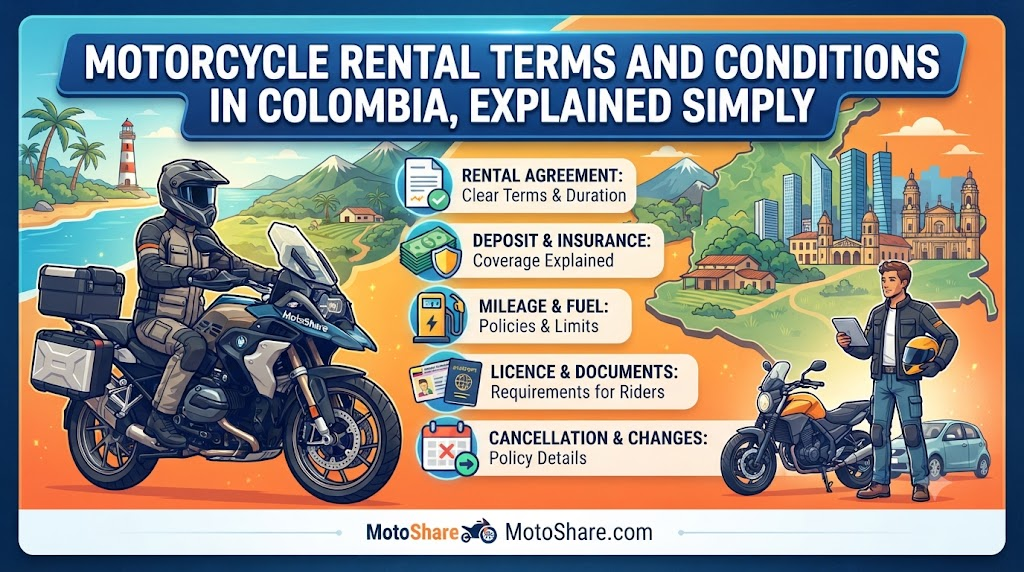
A longer trip makes rental terms matter even more. Here is each item in plain words.
- Rental length and total price. Work out the full cost for every day, including rest days.
- Security deposit. The provider holds this money in case of damage or problems. Ask how much it is and when it comes back.
- Additional charges. Look for fees for late returns, damage, cleaning, or extra equipment.
- Insurance. Read what it covers and what it excludes. Exclusions are the situations where it will not pay.
- Mileage limits. A road trip can use up a distance limit fast. Check it against your route.
- Fuel arrangement. Some providers want the same fuel level on return.
- Cancellation and refunds. Learn what happens if the weather or your plans change.
- Pickup and return. Confirm the place and time. Ask about one-way trips if you need them.
- Licence, age, and documents. Make sure you can meet every requirement.
Terms differ between providers, vehicles, cities, and rental periods. Never assume two listings follow the same rules.
Getting Ready for a Long Day in the Saddle
A long riding day asks more of you than a short city ride.
Choose a bike for the road. Think about the surface, trip length, luggage, weather, and your skill. If you are looking at adventure motorcycle rental Colombia, picture the roads you will really ride and be honest about whether you can handle that bike on them.
Wear proper gear. A helmet that fits well is the most important item. Add gloves, a sturdy jacket, long trousers, closed shoes, and a rain layer.
Prepare your navigation. Save offline maps. Mountain areas can lose phone signal.
Plan fuel stops. In quiet regions, stations can be far apart. Fill up before long empty stretches.
Take rest breaks. Stop to drink water, eat, and stretch. Tiredness is a real risk on long days.
Make an emergency plan. Save the provider’s phone number, and know how to describe where you are.
Check the vehicle. Look at the tyres, brakes, lights, mirrors, and horn. Take photos of any marks before you leave.
Unfamiliar roads can bring sudden rain, fog, loose stones, and delays. Careful planning does not remove those risks, but it makes them much easier to handle.
How to Build a Route That Works in Colombia
A road trip plan is mostly a list of honest answers. Work through these in order.
- Distance and time available: estimate in hours, not just kilometres. Mountain roads are slower than they look on a map.
- Weather: check the forecast for each day, and for the places you will pass through.
- Road conditions: city streets, mountain roads, and rural roads each need different care.
- Fuel stops: know where you can refuel along the way.
- Accommodation: book ahead, so you never have to ride or drive tired and late.
- Places to see: leave room for stops, photos, and meals.
City roads bring buses, taxis, and heavy traffic. Mountain roads bring bends, steep climbs, and weather that can change quickly. Rural roads can be quiet but may have potholes, animals, or loose gravel. Each needs a different pace and a calm, alert style.
Some travellers prefer to ride with a group and a guide. If you are thinking about motorcycle tours Colombia, ask the organiser about:
- The exact route and daily distances
- The size of the group
- The guide’s experience
- What the price includes, such as the bike, fuel, hotels, or meals
- The safety rules
Check these details directly, and do not rely on a route, price, or date until you have it in writing. If a motorcycle road trip Colombia is your goal, build a plan that matches your time, your skill, and the season, and leave a little spare time for the unexpected.
When Four Wheels Make the Trip Easier
A car is often the better partner for a road trip when:
- You are travelling with friends, family, or colleagues.
- You are carrying large bags or equipment.
- The group has mixed riding experience.
- The forecast is wet or cold.
- You will cover long distances and want to share the driving.
- You are travelling with children or older relatives.
Here is how the main car types differ:
- Hatchbacks are compact and easy to park, good for light luggage and city streets.
- Sedans have a separate trunk and a comfortable feel on longer drives.
- SUVs are taller and roomier, with space for more people and bags.
When you compare car rental Colombia listings, look at passenger capacity, luggage space, total price, insurance, deposits, mileage rules, and pickup arrangements. For a group leaving a hilly city, car rental Medellin may be a practical option to compare with several motorcycles. Ask where you can park overnight at each stop, because parking can be limited in busy towns.
Colombian Driving and Rental Rules to Confirm Before You Go
Rules can change, and they do not apply in the same way to every traveller or vehicle. On a road trip, you may pass through several cities, so check carefully.
- Driving licence. Many short-stay visitors can use a licence from their home country, but confirm that yours is accepted. If you plan to ride, confirm that it covers motorcycles.
- Insurance. Colombia requires basic traffic insurance known as SOAT. Ask how it applies to your rental and what extra cover is possible.
- Vehicle documents. Ask which papers you must carry on the road.
- Age limits. Providers may set their own minimum ages.
- Helmet rules. Always wear a proper helmet on a motorcycle or scooter.
- City restrictions. Some cities limit when certain vehicles may be on the road.
Providers can also ask for more than the law requires. Use official government sources and the provider’s own terms, and ask when something is unclear.
Why Good Preparation Makes the Journey Smoother
Preparation does not remove surprises, but it makes them smaller.
- Check the weather for each travel day.
- Choose a vehicle that fits your route and your skill.
- Read and understand every rental term.
- Keep your documents together, and carry copies.
- Allow extra time for every leg of the trip.
A realistic plan keeps the trip calm even when the weather or the road changes your day.
Five Steps to Plan Your Rental
These are general recommendations, not a description of MotoShare’s booking system.
- Choose your destination, dates, and vehicle type. Everything else depends on these three.
- Compare listings, rental periods, and total prices. The daily rate alone does not show the full cost.
- Review the provider’s terms. Pay close attention to insurance, deposits, and cancellations.
- Check licence rules, documents, safety needs, and pickup arrangements. This avoids stress on collection day.
- Review everything before you confirm. A final check can catch a wrong date or a missing detail.
Common Rental Mistakes and How to Avoid Them
- Choosing a motorcycle that is too hard to handle. Pick one you can control comfortably, especially on long days.
- Looking only at the daily price. Add the deposit, fuel, fees, and insurance to see the real cost.
- Ignoring insurance exclusions and deposit rules. Read these sections carefully.
- Forgetting pickup and return details. Confirm place and time in writing.
- Planning a long ride without checking weather and roads. Check the forecast and add extra time.
- Assuming a vehicle is available. Check your exact dates.
- Not understanding the cancellation policy. Read it before you pay.
Example: Four Colleagues Plan a Weekend Trip
Four colleagues in Bogotá want a weekend trip to a hilly, green region outside the city. Two of them ride motorcycles regularly. One has only ridden a scooter. The fourth has never ridden at all. Each person brings a small suitcase.
First, they think about motorcycles. Two riders could go by bike, but the other two would need a vehicle too, and the least experienced person would be riding unfamiliar roads with luggage. Then they think about a car. An SUV could carry all four people and all four bags in one vehicle, and they could take turns driving.
Next, they look at the route and weather. The road has long climbs and bends. The forecast shows rain on Saturday. That makes the car feel safer and more comfortable for the group.
They read the rental terms for both options. They compare the total price, the deposit, the insurance, the fuel rule, the mileage limit, and the return time. They also confirm that their licences are accepted and that they have the right documents.
In the end, they choose an SUV. Their choice comes from the group size, the mixed experience, the luggage, and the weather. They agree that the two experienced riders may plan a separate motorcycle trip another time, when conditions are better and everyone has more time.
Frequently Asked Questions
How many days should a first road trip last?
Start with a trip you can enjoy without rushing. Three to five days is often manageable, but the right length depends on distance, weather, and how much you want to see.
Is it safe to drive or ride at night?
Night travel on unfamiliar roads can be harder, because visibility is lower and hazards are harder to see. Many people plan their days so they arrive before dark.
Can I take the vehicle to another city?
Rules vary by provider. Ask whether you can travel outside the pickup city, and check whether there are distance limits or extra conditions.
What emergency items are useful on a long trip?
A charged phone, a power bank, water, a basic first-aid kit, and the provider’s contact number are all useful. Ask the provider what comes with the vehicle.
How can a group share driving fairly?
Agree on shifts before you leave, and swap before anyone gets tired. Make sure every driver meets the provider’s licence and age rules.
What if I need to extend my rental?
Contact the provider as early as you can. Extensions depend on availability and the provider’s terms, so do not assume they will be possible.
How do I plan for sudden mountain weather?
Check the forecast each morning, carry rain gear, and keep your schedule flexible. Be ready to stop early or change your route when conditions turn bad.
Which documents should I check before booking?
Check your driving licence, ID, the rental agreement, the insurance details, and any age rules the provider sets. Use official sources for current requirements.
Conclusion
A good road trip starts with a good plan. Know your route, choose a vehicle that fits your group and your skill, read the rental terms slowly, and confirm the rules that apply to you. A little time spent on these steps can make the whole journey calmer and more enjoyable.
MotoShare can be a helpful place to start exploring motorcycles, scooters, and cars from local providers in Colombia. Take your time, ask questions, and enjoy the road.
Leave a Reply